
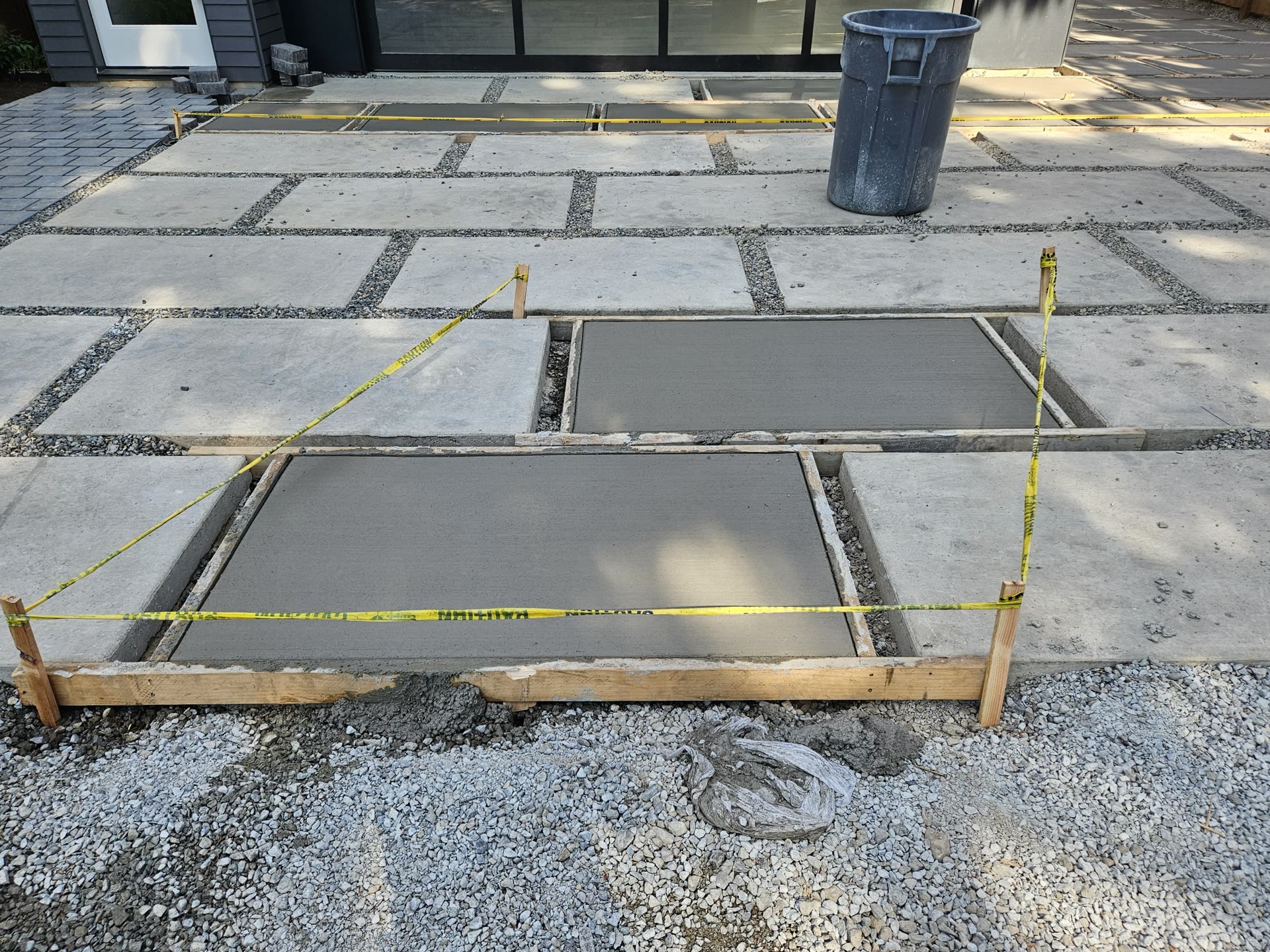
▲ Site Work
What Happens on Your Property During a Concrete Tear-Out
Before new concrete goes in, the old has to come out. If you have not been through a tear-out before, it helps to know what to expect.
Getting ready
Vehicles move off the area, and anything close by that needs protecting is pointed out. We agree the route in and out for equipment.
Breaking it up
The slab is broken into manageable pieces. It is loud work. Steel in the old concrete is cut as it comes out.
Loading and hauling
Broken concrete is loaded and hauled off. Our post on where old concrete goes explains what happens to it.
What it leaves
Once the slab is out, you see the ground it sat on. That is often the moment it becomes clear why the old slab failed: soft ground, no base, or water damage.
Into grading
The ground is then cut, filled and compacted for the new pour, which is why tear-out, grading and pour are booked as one job.
What to look at before the work starts
A tear-out goes more smoothly when you have walked the area yourself. Look at what sits right up against the old concrete: siding, a garage door, steps, fence posts, planting beds, sprinkler heads and lights along the edge. Anything that touches the slab may be disturbed when the slab is broken and lifted, so it helps to say what has to stay and what can go. Check for downspout drains or pipes that run under or out of the old slab, since they often show up only when the concrete comes out.
Think about the route equipment and loaded material will take. A wide, firm driveway is the easiest path. A narrow side yard, a gate, a soft lawn or a septic area along the way changes how the work is planned. Point out septic tanks and lines, water lines, buried electric and irrigation you know about, because the ground near them is treated with more care.
What you will notice on the day
Breaking concrete is noisy and it makes dust, so most people plan to keep pets and children away from the work area and close nearby windows. The ground may shake a little near the slab while it is being broken. Vehicles need to stay out of the area, and a neighbour sharing a drive or a street frontage will appreciate a word beforehand. Once the broken pieces are loaded, the area is left as bare ground ready for the next step.
Terms you may hear
Tear-out and demolition both mean breaking out old concrete and removing it. Haul-off is carrying the broken material away from your property. Subgrade is the native ground the old slab sat on. Base is the crushed rock layer that goes over the subgrade before new concrete. Grading means cutting high spots and filling low ones so the ground has the right shape and fall. Compaction is pressing the ground and base down in layers so they will not settle.
How the decision usually goes
Some homeowners wonder whether the old slab could stay and be covered instead. When the slab has sunk, heaved or broken up, the problem is almost always underneath it, so covering it would carry the same problem into the new work. Taking it out lets the ground be checked and corrected. The other common decision is how much area to remove. Sometimes only a section has failed, and sometimes it makes more sense to replace the whole slab so the new work is level and consistent throughout.
The demolition and grading page covers the work, the driveway page covers what usually follows, and the cost guide explains removal costs.
Our Demolition and Grading page explains how old concrete is broken out and the ground prepared.
Common questions
Do I need to be home during the tear-out?
Not always, but it helps to be reachable, and to have pointed out anything that has to stay or that sits underground before the work begins.
Will the lawn next to the slab be damaged?
Ground right beside the old concrete is usually disturbed as the slab is broken and lifted out. Planning the equipment route ahead of time keeps the rest of the yard as undisturbed as possible.
Can part of a slab be removed and the rest kept?
Sometimes. A clean cut line can separate a failed section from sound concrete. Whether that makes sense depends on how the rest of the slab has held up and how the new section will meet it.
Ready to talk about your project? Request a free estimate.
Get your free estimate
- 1You send the form.
- 2We get in touch.
- 3We come and look at the job.
- 4You get it in writing.
- 5You decide.
Call
(253) 271-4640Hours
- Monday–Friday, 7 a.m.–7 p.m.
- Saturday, 7 a.m.–3 p.m.
- Closed Sunday
Based in
Orting, WA
Request Your Free Estimate
No pressure, and no obligation. We come and look at the job before we give you a number.