
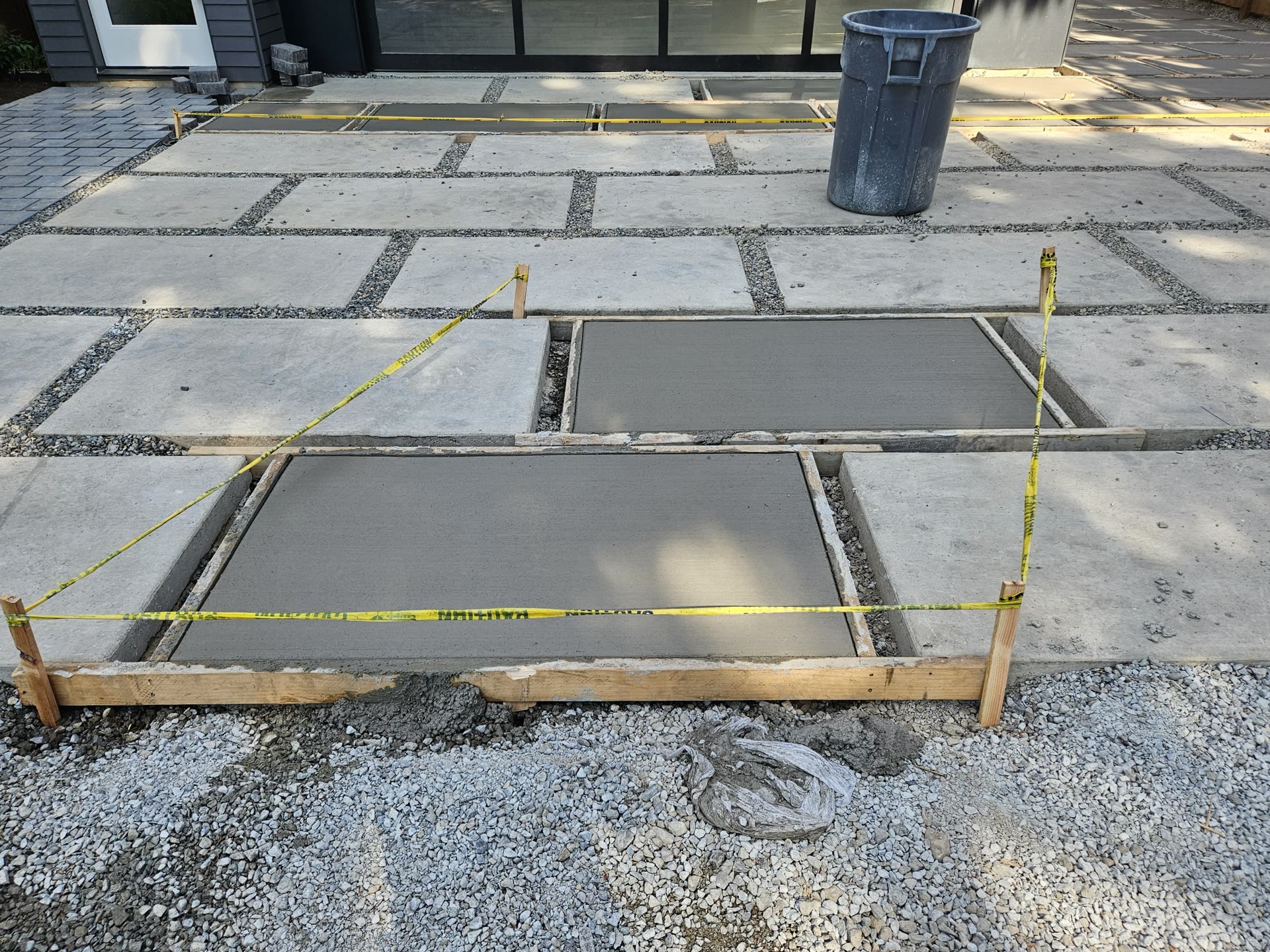
▲ Patios and Walkways
Planning a Walkway From the Drive to the Front Door
A front walk gets used by everyone who comes to the house, from guests to delivery drivers. Planning it well means thinking about where people actually walk, not just where a line looks tidy on a plan.
Follow the natural route
People take the shortest comfortable path. If the walk goes the long way around, a worn track in the lawn usually tells the story within a season. Look at where people already cut across, and start the plan there.
Where it starts and ends
A walk that starts at the drive should meet it cleanly, at the same level, without a lip to catch a foot or a wheel. At the door, it should arrive at a landing or a step that makes sense, with enough flat space to stand while the door opens.
Width
A walk that two people can use side by side feels welcoming at a front door. Side paths to the bins or the back gate can be narrower. The walkway width post goes into this further.
Slope and drainage
The walk has to shed water. A slight cross-slope moves rain off one side, and the walk should never send water toward the house. Where the yard slopes steeply, the walk may need steps or a landing partway.
Lights, beds and roots
Think about what sits alongside: planting beds, lights, a mailbox, trees. Roots near a walk can lift it over time, and that is worth talking about before the pour.
What to look at on your own property
Stand at the drive and look toward the front door. Notice the line your eye takes and the line your feet want to take. Then walk it in the rain. A front walk in western Washington gets wet through much of the year, so look for low spots in the lawn where water sits, downspouts that empty near the route, and shaded areas where moss grows. A walk laid through one of those spots will be slick and may need more care with slope.
Look at the heights at each end. The driveway edge sets the level at one end and the door threshold or porch sets it at the other. If the difference is small, the walk can climb gently along its length. If it is large, steps or a landing may be needed partway. Note anything in the way: a tree, a planting bed, a mailbox, a light, or a buried line you know about.
Plain explanations of the terms
A tie-in is where the new walk meets existing concrete, such as the driveway or the porch. A lip is a small step up or down where two surfaces meet, which is easy to trip on. Cross-slope is a slight tilt from one side of the walk to the other that sheds rain. A landing is a flat area, often at the door or at a turn. Control joints are the lines tooled or cut across the walk to guide where shrinkage cracks form. An isolation joint separates the walk from the drive, steps or house so each can move without pushing on the other.
Trade-offs to weigh
A straight walk is simple to form and easy to clear, but it may not follow the path people take. A curved walk can follow the natural route and soften the front of the house, at the cost of more forming. A wider walk is more welcoming and easier to use with a stroller or a cart, but it takes more of the front yard. A broom finish gives grip in the wet; stamped and topcast give more texture and colour, chosen at the time of the pour, and all three can work on a front walk.
How the decision usually goes
Most homeowners settle the route first, often by following an existing worn track. Then the width is chosen to suit the front door and how many people use it. The heights at each end decide whether steps or a landing are needed. The finish usually comes last, often chosen to sit well beside the driveway and the porch.
The walkway page, the concrete stairs page and the cost guide are good next reads before your estimate.
Our Concrete Walkways page explains how a walk is laid out, prepared and poured.
Common questions
Should the walk be the same finish as the drive?
It does not have to be. Many people match them for a tidy look, and some choose a different finish to set the walk apart. Either is decided before the pour.
What if a tree is close to the route?
Roots can lift a walk over time. It helps to talk about the tree before the pour, so the route, the base and the joints can be planned around it.
Can the walk curve around a planting bed?
Yes. Curves take more forming, but they let the walk follow the shape of the bed and the way people move to the door.
Ready to talk about your project? Request a free estimate.
Get your free estimate
- 1You send the form.
- 2We get in touch.
- 3We come and look at the job.
- 4You get it in writing.
- 5You decide.
Call
(253) 271-4640Hours
- Monday–Friday, 7 a.m.–7 p.m.
- Saturday, 7 a.m.–3 p.m.
- Closed Sunday
Based in
Orting, WA
Request Your Free Estimate
No pressure, and no obligation. We come and look at the job before we give you a number.