
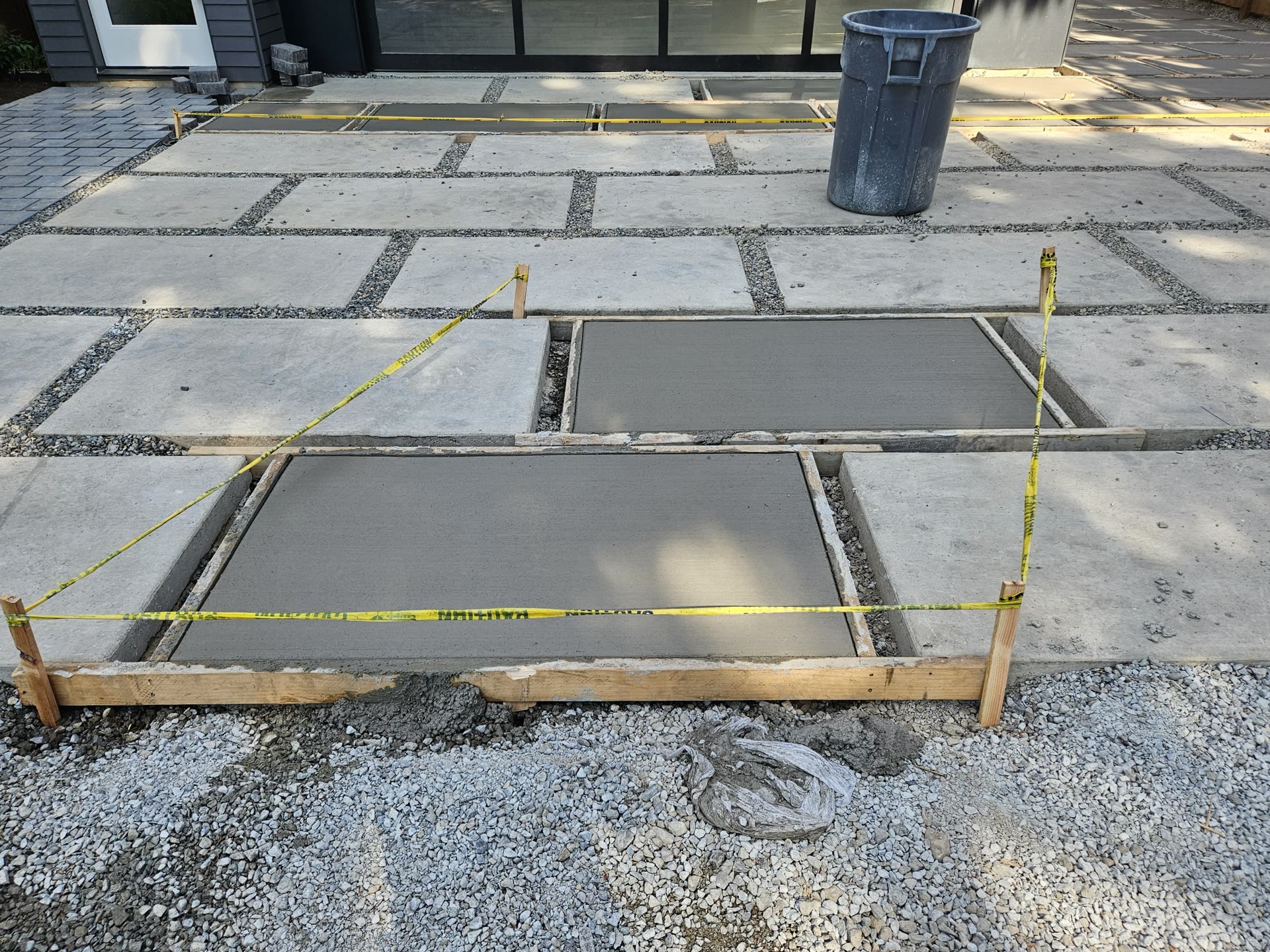
▲ Patios and Walkways
Control Joints and Cracking on Walkways: What to Expect
If you look at almost any concrete walk, you will see lines across it at regular intervals. Those are control joints, and they are there because all concrete cracks. The joints decide where.
Why concrete cracks
Concrete shrinks as it cures and moves with temperature and moisture afterwards. That movement has to go somewhere. Without joints, it shows up as random cracks wherever the slab is weakest.
What a joint does
A control joint is a groove, tooled while the concrete is fresh or sawn soon after, that creates a deliberate weak line. When the slab cracks, it cracks at the bottom of the groove, where you do not see it. On a narrow walk, joints are spaced fairly closely to keep each section well proportioned.
Hairline cracks are normal
Even with good joints, a hairline crack can appear between joints. That is normal shrinkage and not a sign of a failing walk. What matters is whether a crack stays tight and level.
Cracks worth noticing
A crack that opens wide, or where one side drops below the other, usually points to something under the slab: soft ground, water washing out the base, or roots pushing up. Those are base problems, not surface problems.
What helps
A compacted, draining base, sensible joint spacing, and thinking about trees near the walk. Our post on why concrete cracks goes deeper, and the cost guide explains how base preparation affects price.
What to look at on your own walkway
Walk the length of your walk and look at each crack. Note whether it sits at the bottom of a joint or runs across a section between joints. Look at how wide it is and whether one side sits higher than the other. A tight crack you can barely feel is normal shrinkage. A step you can catch a toe on is a trip hazard and a sign of movement below. Look at what is beside the worst spots: a tree, a downspout, a low area where water stands, or an edge where soil has washed away.
In Pierce and King County, the wet months test the ground under a walk. Water running along a walk's edge can carry fine soil away from under it, and an edge that has lost support may crack and drop. Roots from trees and large shrubs can lift a section and crack it. Watching the same cracks through a wet season shows whether they stay put or keep moving.
Plain explanations of the terms
A control joint is a groove that makes a planned weak line in the slab. A tooled joint is formed with a hand tool while the concrete is fresh. A sawn joint is cut with a saw once the concrete has hardened enough. Joint spacing is the distance between joints. A panel, or section, is the area of concrete between joints. An isolation joint separates the walk from something else, such as a step, a wall or another slab, so each can move on its own.
Trade-offs in joint layout
Closer joints make smaller, squarer sections that are less likely to crack between joints, but they add more lines to the surface. Wider spacing gives a cleaner look with fewer lines, but each section is more likely to crack somewhere in the middle. Tooled joints have a soft, rounded edge and are made during finishing; sawn joints give a sharp, straight line. Placing joints where the walk changes direction or meets a step helps guide cracks to places where they are expected.
How the decision usually goes
Most homeowners notice joints only once a crack appears. When planning a new walk, the joint layout is set with the width, shape and finish, so the lines suit the walk and fall where cracks are most likely. Where an old walk has wide or displaced cracks, the usual question is whether the base has failed, and if so, the affected sections are often replaced on a new base.
Our Concrete Walkways page explains how walks are laid out, jointed and poured.
Common questions
Can joints be added after the walk is poured?
Joints are sawn soon after the pour while the concrete is still young. Once cracks have formed, adding joints does not move them.
Is a crack between joints a failure?
A hairline crack between joints is normal shrinkage. A wide crack or one that drops on one side points to the base.
Should I worry about a tree near the walk?
It is worth watching. Roots can lift and crack a walk as they grow, so keeping a new walk back from large trees helps.
Ready to talk about your project? Request a free estimate.
Get your free estimate
- 1You send the form.
- 2We get in touch.
- 3We come and look at the job.
- 4You get it in writing.
- 5You decide.
Call
(253) 271-4640Hours
- Monday–Friday, 7 a.m.–7 p.m.
- Saturday, 7 a.m.–3 p.m.
- Closed Sunday
Based in
Orting, WA
Request Your Free Estimate
No pressure, and no obligation. We come and look at the job before we give you a number.