
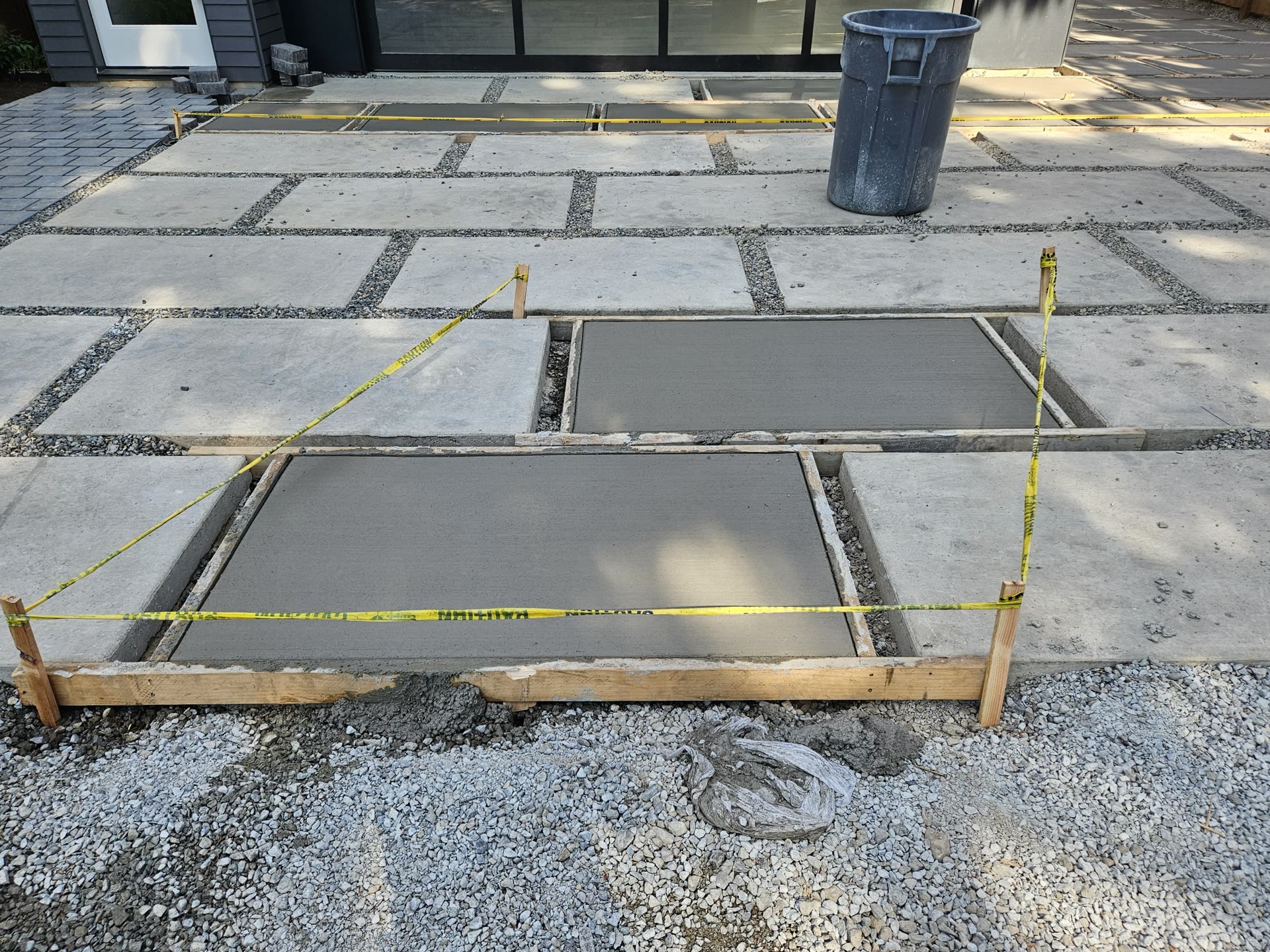
▲ Driveways
Why Concrete Cracks, and Which Cracks Actually Matter
Anyone who tells you a concrete slab will never crack is not telling you the truth. All concrete moves. The useful questions are where it cracks, how much, and whether it matters.
Shrinkage
Concrete loses water as it cures and gets slightly smaller. That shrinkage pulls against the ground and the slab's own edges, and cracks relieve it. Hairline shrinkage cracking is normal in any slab.
Temperature and moisture
After curing, a slab keeps expanding and contracting with heat, cold and wet. Over the seasons, that movement adds up.
What joints do
Control joints give the slab weak lines so cracks form there, in the groove, rather than across the middle of a panel.
What reinforcement does
Steel keeps cracked sections tied together so they stay tight and level. It does not stop cracking.
Cracks that matter
A crack that opens wide, keeps growing, or lets one side drop below the other usually points to the base: soft ground, washout or poor compaction. Those are the cracks worth worrying about.
How to reduce the risk
A firm, compacted, draining base; the right thickness; sensible joints; reinforcement suited to the use; and placing concrete when conditions allow. The flatwork problems guide, the driveway page and the cost guide go further.
What to look at on your own slab
Walk your drive, walk or patio and look at each crack. Note how wide it is, whether it runs straight across or wanders, and whether it sits in a joint or between joints. Run a hand or shoe across it. A crack you can feel as a step, with one side higher than the other, is different from one that is flat and tight. Look at what is near the worst cracks: a downspout, a tree, a low spot where water stands, or the spot where a car or trailer is parked.
Look at the ground beside the slab as well. In Pierce and King County, the wet months can soften ground and wash fine soil out from under an edge. Soil that has washed away from a slab edge, a gap under the edge, or a section that rocks when you step on it all point to a problem below. Watching the same cracks over a season tells you whether they are stable or getting worse.
Plain explanations of the terms
Shrinkage is concrete getting slightly smaller as it loses water while curing. A hairline crack is a very fine crack that stays tight. Displacement is when one side of a crack sits higher or lower than the other. Heave is upward movement, often from roots or ground swelling. Settlement is downward movement from soft or poorly compacted ground. Washout is fine soil carried out from under a slab by water. A control joint is a groove that creates a planned weak line so cracks form there.
Trade-offs in reducing cracking
Closer joint spacing gives more, smaller panels and better control of where cracks form, but adds more lines to the surface. Thicker concrete and more steel help a slab carry heavy loads and keep cracks tight, but they add material. A deeper, well-compacted base takes more work up front and protects against settling, which is the cause of the cracks that matter most. Waiting for the right conditions to pour can move a date, but it avoids cracking linked to wet ground and poor curing.
How the decision usually goes
Homeowners with a few tight hairline cracks usually choose to leave them, since they are part of how concrete behaves. Where cracks are wide, displaced or growing, the cause is usually below the slab, and patching the surface does not change it. In those cases, many choose to replace the affected section or the whole slab, with the base and drainage planned so the new slab sits on firm ground.
Our guide to Problems With Concrete Flatwork covers cracking alongside wet winters and drainage.
Common questions
Is a crack in a new slab a sign of a bad job?
A hairline shrinkage crack in a new slab is normal. A crack that opens wide or drops on one side points to something worth looking into.
Can cracks be prevented entirely?
No. Joints, reinforcement and a good base control where cracks form and keep them tight, but some cracking is part of how concrete behaves.
Why did my slab crack near the tree?
Roots can lift a slab as they grow, and they can also dry out or disturb the ground under it. Either one can lead to cracking near a tree.
Ready to talk about your project? Request a free estimate.
Get your free estimate
- 1You send the form.
- 2We get in touch.
- 3We come and look at the job.
- 4You get it in writing.
- 5You decide.
Call
(253) 271-4640Hours
- Monday–Friday, 7 a.m.–7 p.m.
- Saturday, 7 a.m.–3 p.m.
- Closed Sunday
Based in
Orting, WA
Request Your Free Estimate
No pressure, and no obligation. We come and look at the job before we give you a number.